



The foundation TypeScript library of Selldone: typed models, enums, helpers and the API base classes shared by every storefront, dashboard, SDK and component.
Documentation ·
Quick start ·
Ecosystem ·
Selldone.com ·
Report an issue
Storefront · Page Builder · Components · Storefront SDK · Backoffice SDK · Vendor SDK · Community SDK · Core · CLI · Translate
Selldone® Core (@selldone/core-js) is the foundational JavaScript/TypeScript library of Selldone Business OS. It defines the shared language of the platform: typed models for shops, products, orders, customers and vendors; enums for currencies, languages, product types and routes; helpers for prices, dates, URLs and local storage; and the HTTP base class (APIAbstract) with caching that all Selldone SDKs extend.
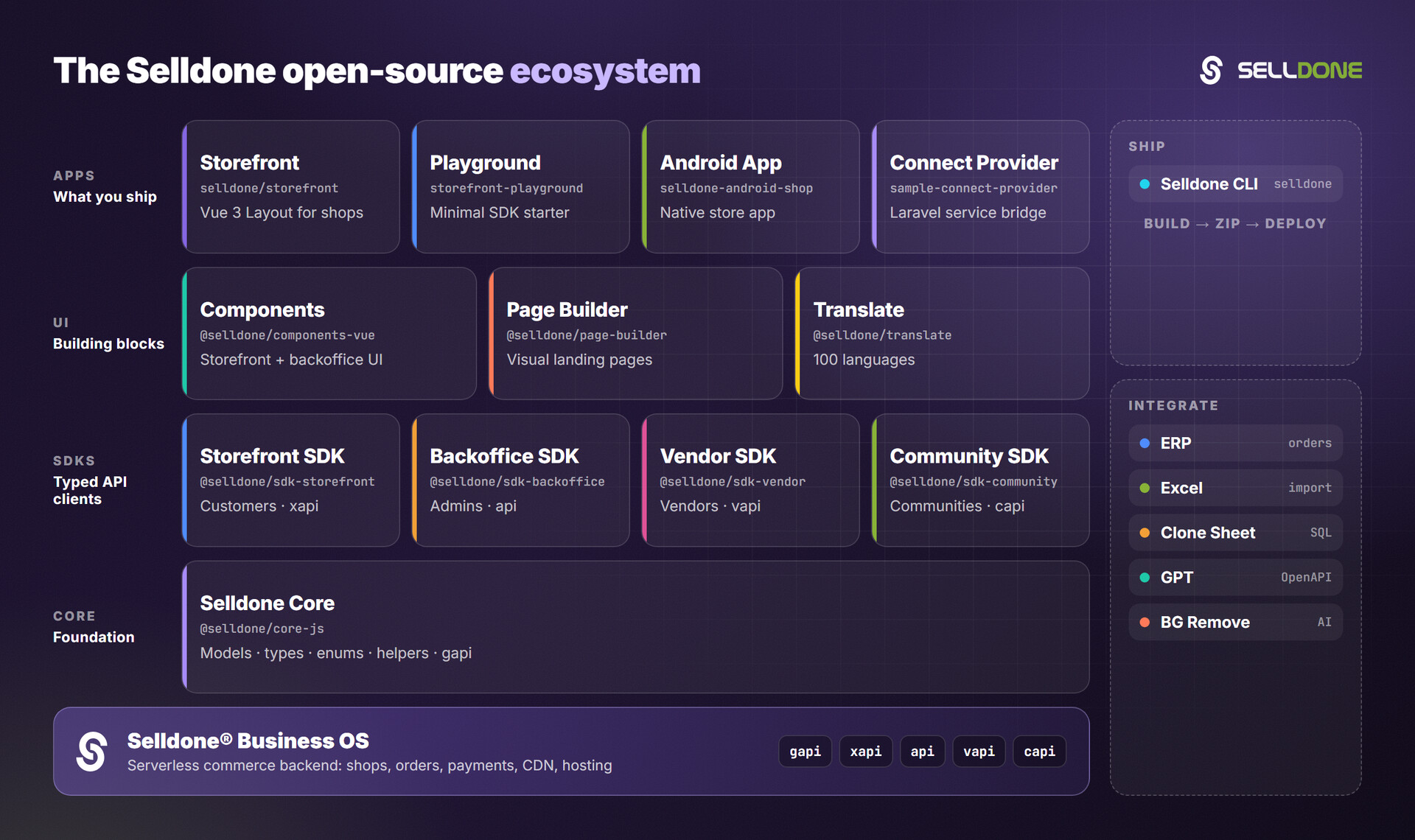
Every other front-end package builds on it. The Storefront SDK, Backoffice SDK, Vendor SDK, Community SDK, Components, the Page Builder and the Storefront app all import their types and utilities from here.
Use it directly when you build an app for both storefront and backoffice, write your own Selldone API client, or simply need correct TypeScript types and helpers for Selldone data.
- Typed models (
models/) — about 100 classes and interfaces for shops, products, variants, categories, baskets, bills, customers, users, vendors, incentives, logistics, articles and community, documented against their backend source fields. - Enums and catalogs (
enums/) — 153 currencies with formatting rules, 99 languages with locale and direction, product and order types, transaction statuses, permissions, business models and the route names of the Storefront, Backoffice and Community apps. - Helpers (
helper/) — price and exchange-rate calculations, currency formatting, relative dates, Persian/Arabic digit conversion, shop and product URLs, local-storage keys, CSV import formats, SEO scoring, an LRU cache and more. - API base class (
server/APIAbstract) — GET/POST/PUT/DELETE helpers with response caching (optimize,cache), forced refresh and request cancellation. - Runtime services (
server/) —SetupServicereads configuration from meta tags;CDN,URLSandGAPIbuild media and API URLs. - General API client (
gapi/) —window.$selldone.gapi, for examplefetchCountries(). - Utilities (
utils/) — cookies, styled console output (console.style), slugify, debounced search, file, scroll and theme helpers, service-worker registration. - Prototype extensions (
prototypes/) — handy methods such asArray.prototype.limit,sumByKey,uniqueByKey, andString.prototype.ellipsis. - Analytics time series (
timeserie/) —TimeSeriesturns daily statistics into today, yesterday, weekly and monthly views and chart datasets.
1. Install
npm install @selldone/core-jsyarn add @selldone/core-jsThe package entry point is the TypeScript source (index.ts), and some enums import image assets (.svg, .png). Use a bundler that handles both, such as Vite.
2. Add the meta tags that Selldone Core reads at start-up (shown with the public Selldone endpoints):
<meta content="https://selldone.com" name="service-url">
<meta content="https://gapi.selldone.com" name="selldone-gapi">
<meta content="https://iframe.selldone.com" name="selldone-iframe">
<meta content="https://selldone.com/cdn-shop-images-1" name="selldone-cdn-images">
<meta content="https://selldone.com/cdn-shop-jsons-1" name="selldone-cdn-jsons">
<meta content="https://selldone.com/cdn-ar" name="selldone-cdn-ar">
3. Set up
import { SelldoneCore } from "@selldone/core-js";

SelldoneCore.Setup();
To let Core helpers (validation rules, address formatting…) translate their messages, pass your i18n instance:
SelldoneCore.Setup({ i18n: i18n.global }); // e.g. a vue-i18n instanceSetup() configures window.axios (CORS and CSRF headers), creates window.CDN, window.URLS, window.GAPI, window.$selldone.gapi and window.$cookies, and stores the i18n instance as window.$i18n_global. If you use the Storefront SDK, StorefrontSDK.Setup() calls it for you.
The package root re-exports SelldoneCore, helper/, models/, server/, utils/ and prototypes/. Enums, gapi/, timeserie/ and types/ are imported by path:
import { SelldoneCore, PriceHelper, DateConverter, ShopURLs } from "@selldone/core-js";
import type { Shop, Product, Basket } from "@selldone/core-js";

import { Currency } from "@selldone/core-js/enums/payment/Currency";
import { Language } from "@selldone/core-js/enums/language/Language";
import { StorefrontRoutesName } from "@selldone/core-js/enums/route/StorefrontRoutesName";
import { TimeSeries } from "@selldone/core-js/timeserie/TimeSeries";
Importing the package root also installs the prototype extensions (for example Array.prototype.limit and Date.prototype.addDays).
import { Product, Customer } from "@selldone/core-js";
import { Currency } from "@selldone/core-js/enums/payment/Currency";

Product.ProductType.PHYSICAL;  // "PHYSICAL"
Customer.Source.CUSTOMER;      // "customer"
Currency.EUR.unicode;          // "€"
Currency.USD.floats; // 2import { PriceHelper, CurrencyHelper } from "@selldone/core-js";
// Final price of a product (and variant) in the customer's currency,
// using the exchange rates in shop.shop_exchange_rates
const price = PriceHelper.priceProductByCurrency(shop, product, variant, "EUR");
CurrencyHelper.ConvertToString(100.5, "USD"); // "$100.50"
CurrencyHelper.ConvertToString(100.5, "EUR", "de-DE"); // "100,50 €"import { DateConverter, NumberHelper, ShopURLs } from "@selldone/core-js";
DateConverter.getFromNowString(order.created_at, "en-US"); // e.g. "3 days ago"
NumberHelper.toEnglishNumber("۲۵.۵"); // 25.5
ShopURLs.GetProductLink(shop, product.id); // full product URL of the shopwindow.$selldone.gapi
.fetchCountries()
.then((countries) => console.log(countries)); // [{ name, alpha2, alpha3, numeric, currency }]APIAbstract gives your class the same request helpers and cache as the official SDKs:
import { APIAbstract } from "@selldone/core-js";

export class MyCatalogApi extends APIAbstract {
  fetchCountries() {
    return this.getNow<{ name: string; alpha2: string }[]>(window.GAPI.GET_COUNTRIES());
  }
}
const api = new MyCatalogApi();
api
.optimize(300) // reuse a stored response for up to 5 minutes
.fetchCountries()
.cache(render) // render stored data at once and store the fresh response
.then(render);Responses are stored only for requests chained with .cache(), so use it together with optimize(). force() and cancellation() are also available. See Server and APIs.
| Folder | Contents |
|---|---|
models/ |
Shop, product, order, customer, user, vendor, incentive, logistic, article and community models. |
enums/ |
Currencies, languages, product/order types, permissions, routes, statuses and other catalogs. |
helper/ |
Price, currency, date, number, URL, local-storage, CSV, SEO, color, map and more. |
server/ |
SetupService, APIAbstract, CDN, URLS, GAPI. |
gapi/ |
Gapi client (window.$selldone.gapi). |
utils/ |
Cookie, console style, slugify, threads, file, scroll, theme, image, service worker. |
prototypes/ |
Array, String, Number, Object and Element extensions. |
timeserie/ |
TimeSeries analytics helper. |
types/ |
Shared type definitions (route return type, file upload response, asset modules). |
assets/ |
Icons and images used by enums and helpers. |
| Page | What you'll learn |
|---|---|
| Home | What Selldone Core is, page map and where it fits. |
| Getting Started | Install, meta tags, SelldoneCore.Setup(), import paths. |
| Models and Types | How models are organized, namespaces, and the most-used models. |
| Enums | Currencies, languages, product and order types, route names and other catalogs. |
| Helpers and Utilities | Helpers, utils, prototypes and TimeSeries, with examples. |
| Server and APIs | SetupService, CDN, URLS, GAPI, APIAbstract caching, and Gapi. |
| FAQ | Common questions and troubleshooting. |
Selldone Core sits at the bottom of the Selldone front-end stack. The SDKs extend its APIAbstract class and return its models, the Components and Page Builder render its models with its helpers, and the Storefront app ties them together. Keeping these definitions in one package means a product, a basket or a currency looks the same everywhere.
| Project | Why it is relevant |
|---|---|
| storefront-sdk | Customer-facing API client built on Core (window.$storefront). |
| backoffice-sdk | Admin API client built on Core (window.$backoffice). |
| components | Vue 3 commerce components that render Core models. |
| storefront | Production Vue 3 storefront that uses Core end to end. |
| community-sdk | Community API client that uses Core's community models. |
| translate | Translation files for the i18n keys used by Core enums. |
Contributions are welcome. Please read the organization contributing guide and code of conduct. If you find a bug or have a feature request, please open an issue; to contribute code, fork the repository and submit a pull request.
Development notes:
npm run buildcompiles the TypeScript sources withtsc -p tsconfig.json;npm run cleanremoves the build output.- Every push to
maintriggers thenpm-publishworkflow, which builds the package and publishes it to npm, so keepmainreleasable and bump the version inpackage.jsonfor each release. - Many packages depend on Core. Keep model and enum changes backward compatible, and document fields with their backend source as the existing models do.
Please do not report security vulnerabilities in public issues. Read this repository's security policy and email security@selldone.com.
See LICENSE.md for this repository's license file.
Selldone Ecosystem License Agreement
Selldone Ecosystem License Agreement
-
Scope of License: This license is granted exclusively for the use of the enclosed code (hereinafter referred to as "the Code") within the Selldone ecosystem. The licensee is authorized to use the Code solely in conjunction with services and applications that are part of, or directly related to, the Selldone ecosystem.
-
Commercial Use Restriction: The licensee is strictly prohibited from using the Code for any commercial purposes outside the Selldone ecosystem. Commercial utilization is permissible only when it is within the Selldone ecosystem and in accordance with the terms of this agreement.
-
Permission for Free Use: The Code may be used for non-commercial, free services, provided that explicit credit is given to Selldone. This credit must include the name "Selldone" prominently displayed on the user interface of the relevant service or application, along with a hyperlink to selldone.com.
-
No Redistribution: The licensee may not redistribute the Code, in whole or in part, to any third party outside the Selldone ecosystem, unless expressly authorized by Selldone.
-
No Modification for Redistribution: While modifications to the Code for personal or internal use within the Selldone ecosystem are allowed, the licensee may not modify the Code for the purpose of redistribution outside the Selldone ecosystem.
-
Termination: Failure to comply with the terms of this agreement will result in the immediate termination of the license and may subject the licensee to legal action.
-
Disclaimer of Warranty: The Code is provided "as is" without any warranties of any kind, either expressed or implied, including but not limited to implied warranties of merchantability or fitness for a particular purpose.
-
Limitation of Liability: In no event shall Selldone be liable for any damages arising out of the use or inability to use the Code.
-
Jurisdiction and Disputes: This agreement shall be governed by the laws of the jurisdiction where Selldone is established. Any disputes arising from this agreement shall be resolved in the courts of that jurisdiction.
By using the Code, the licensee acknowledges that they have read, understood, and agreed to the terms of this license.
Part of the Selldone® Business OS open-source ecosystem · selldone.com