
Open-source software for compiling and simulating quantum programs, fast, on your own machine.
pip install qevedo| Project | Package | What it does |
|---|---|---|
| qevedo-simulator |  |
qvd, a quantum circuit simulator in Rust with five methods, chosen automatically: an AVX2 state vector, a Stim-style stabilizer simulator, matrix product states, and a Clifford-frame near-Clifford simulator. |
| qcc |  |
QCC, a technology-agnostic quantum circuit compiler: OpenQASM 2/3 in and out, lowered and optimized for a device profile. |
| openqasm |  |
An OpenQASM 2 and 3 parser and semantic checker for Python. |
| qevedo |  |
All of the above in one install. |
from qevedo.compiler import compile_source, emit_qasm
from qevedo.simulator import run

compiled = compile_source(open("circuit.qasm").read())  # native gates of your device
result = run(emit_qasm(compiled), shots=1000)           # the best simulation method, automatically
print(result.counts, result.backend)Measured on one workstation (Intel i9-14900K, 62 GB), against the reference tools on the same circuits:
- State vector: 3–4× faster than Google's qsim and 7–12× faster than Qiskit Aer at 26–30 qubits.
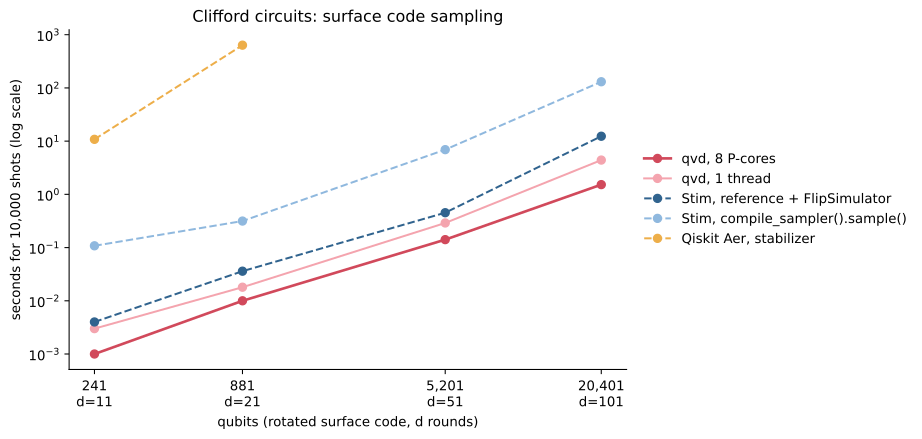
- Clifford circuits: a distance-101 surface code (20,401 qubits, 1M measurements) samples 10,000 shots in 1.5 s, 8× faster than Stim.
- Low entanglement (MPS): 1.6–14× faster than the faster of Qiskit Aer and quimb, with matching fidelity estimates.
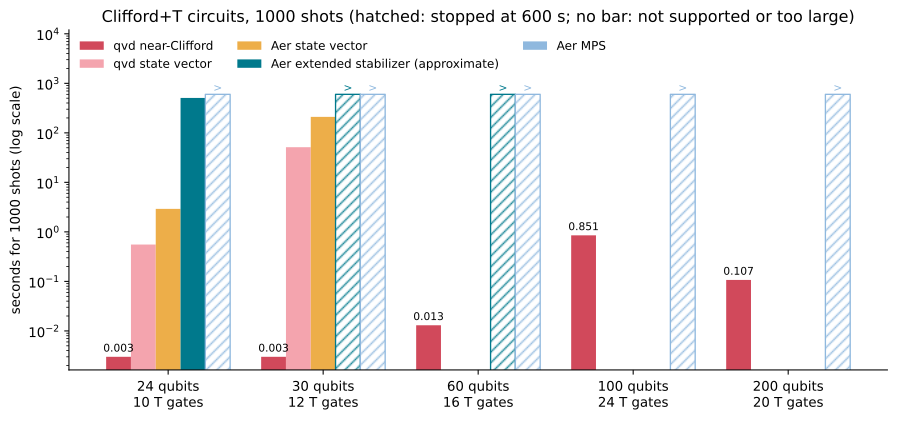
- Clifford + T: 200 qubits with 20 T gates sample in 0.11 s; every Qiskit Aer method takes over 10 minutes or does not support the circuit.
Methods, raw data and how to reproduce every number: qevedo-simulator/benchmarks.
Issues and pull requests are welcome in each repository. Everything is open source under the MIT license.