Repository navigation
fix(compiler): answer an ancestor condition that names no class - #462
YevheniiKotyrlo wants to merge 3 commits into
Conversation


Device evidence — before / afterUNFIXED — All three bars are red. The classless ancestor’s condition is written onto a ref nothing reads, so the rule compiles with no condition and applies under every ancestor. FIXED — Only the first bar is red. [data-state="on"] .probe applies under the ancestor that carries the attribute, and nowhere else.
Android 16 emulator (API 36, GLES on the host GPU), 1140×2400 @ 480dpi, both frames from one run. |
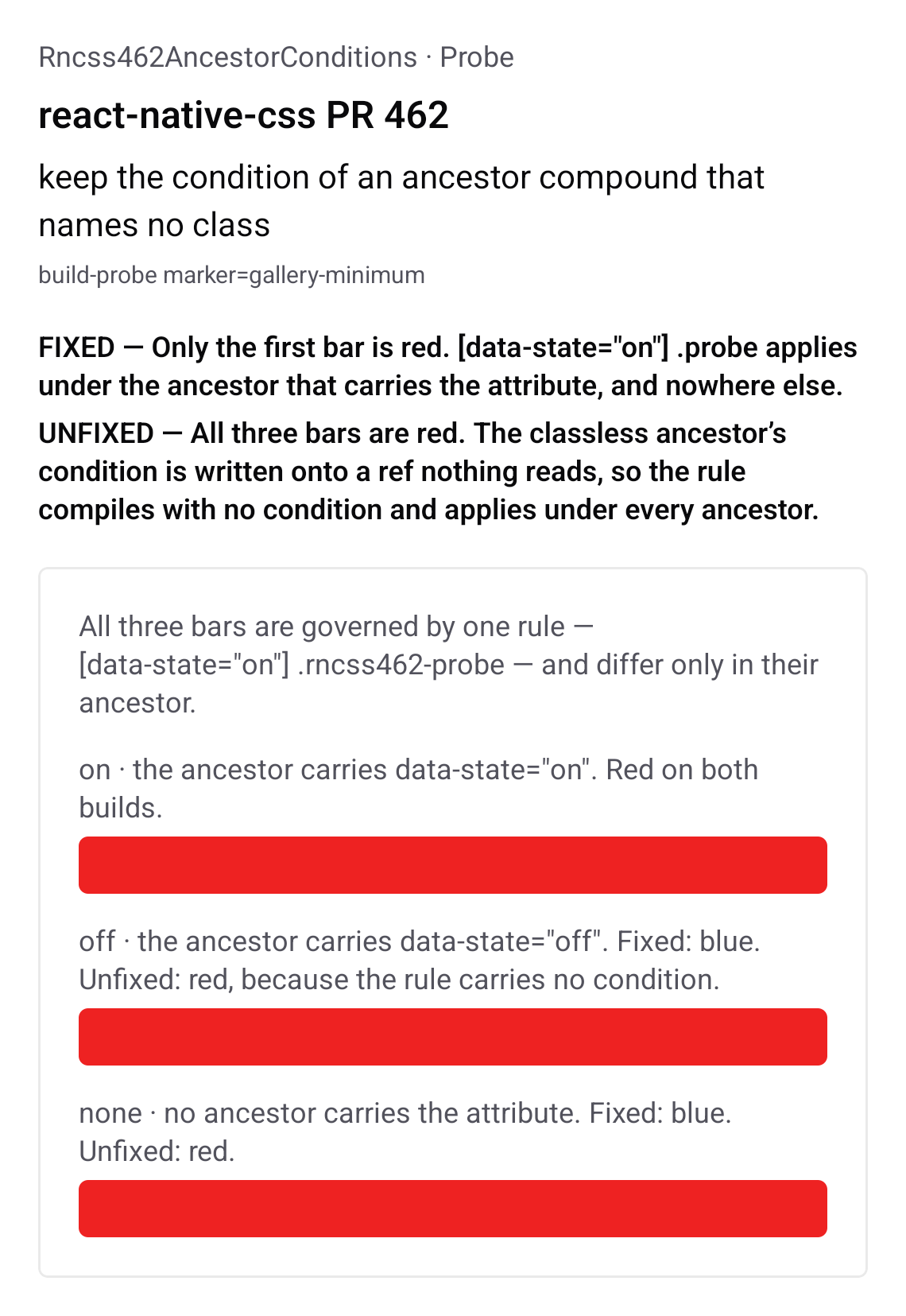
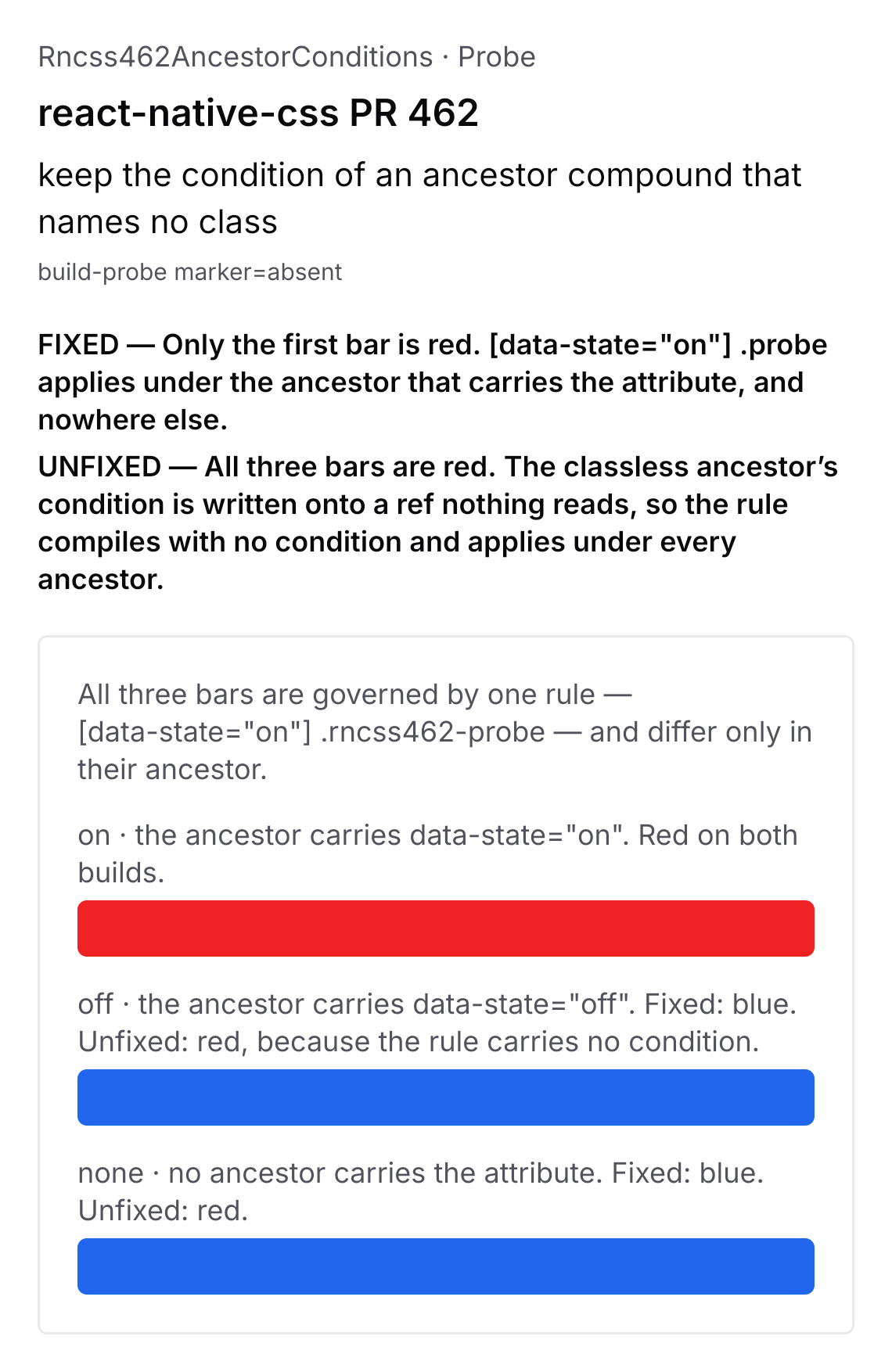
Re-cut onto main (a5002c5). Main keeps an attribute condition's
kebab name, which React Native accepts as a prop.

b6fcc0f to
1b80844
Compare
This branch has not been deployed
1 participant

Problem
A descendant combinator opens a container-query ref, and every later component of that compound writes its condition onto it. Only the
classarm attaches the ref to the rule, so an ancestor identified by a condition alone is discarded and the rule applies to every element the class names, in every state. The container queries each rule compiles to onmain:main[data-state="on"] .x[{"a":[["d","state","=","on"]]}]:hover .x[{"p":{"h":1}}]:disabled .x[{"a":[["a","disabled"]]}].g[data-state="on"] .x[{"a":[…],"n":"g:g"}].x:where([data-state="on"] *)[{"a":[["d","state","=","on"]]}]The last two rows are why this is a defect rather than a limit. The class arm attaches a named query and
parseIsWhereComponentsalready emits an unnamed one for the:where(… *)spelling, so two spellings of one selector disagree, and the one an author writes by hand fails open. A descendant combinator asks for an ancestor matching the whole compound to its left (Selectors 4 §14.1), so a condition in that compound is part of the match.Solution
The ref is attached when a condition is written, not only when a class names it.
attachContainerQueryadds a ref once, so a compound carrying both a class and a condition attaches one query and the named path compiles as before.The condition then resolves against the nearest container, as the
:where()spelling does. With no container above,testContainerQueryanswersfalse, so a selector the runtime cannot answer fails closed.Tests
src/__tests__/compiler/ancestor-conditions.test.ts: each row above, a chain of two classless ancestors, a named and a classless ancestor together, a multi-class compound yielding one query, the combinator compiling to what:where()does, a compound on one element staying the subject's, and an unanswerable combinator still dropping the rule.src/__tests__/native/ancestor-conditions.test.tsx, through the runtime:[data-state="on"]and:disabledancestors following the container's props both waysOn
main, 14 of the 22 cases in the two files fail; all pass here. Removing the attach from the hover, attribute and disabled arms fails their own cases.Every ancestor-state test in the suite names a class, because that is what Tailwind emits:
group-hover:compiles to.group:hover .x, which was already correct. The classless form is what an author writes in a plain stylesheet.Verification
On Windows with Node 26:
yarn lintcleanyarn typecheckcleanyarn test --maxWorkers=2 --coverage: 1353 passed, 4 failed. The 4 are the babel cases that also fail onmainon this machine.yarn buildcleanyarn example expo export --platform webexportedNo existing issue tracks this. I searched for
ancestor attribute selector,data- descendant,hover descendant,group-hoverandparent hover.Device evidence, before and after: #462 (comment)
Known limits
An unnamed query resolves the nearest ancestor that established a container, not any ancestor. That under-matches, as
:where(… *)already does. Going further needs every element to be addressable, and the stylesheet is class-keyed: an element carrying no class the sheet names registers nothing.Independent of #463, which decides the order of an ancestor chain at runtime. They touch no common file.
Merge order
It shares lines with #448 (
compiler/selector-builder.ts), #459 (compiler/selector-builder.ts); whichever lands second rebases.Base
Re-written on
main(a5002c5).